
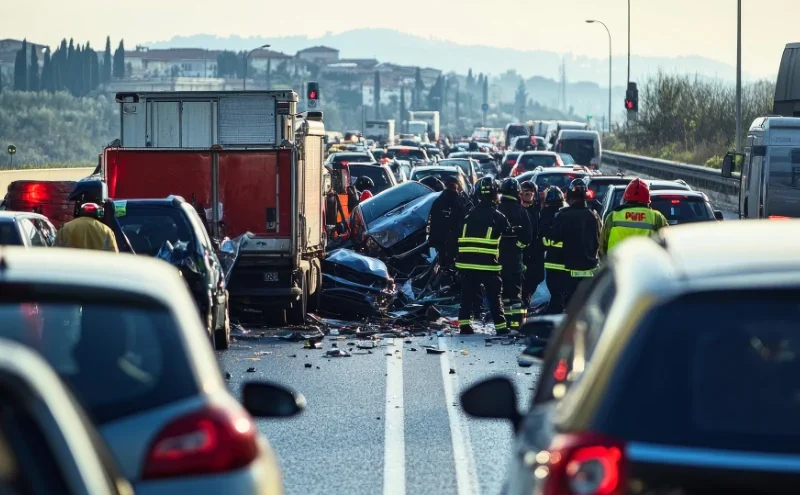
Fault in a multi-vehicle accident in Illinois is determined by examining each driver’s actions, identifying traffic law violations, and establishing how those actions contributed to the collision. Unlike two-car accidents, crashes involving three or more vehicles may involve several negligent drivers and multiple points of impact. Investigators examine police reports, vehicle damage, witness statements, and other evidence to determine who caused the initial collision and whether additional drivers contributed to subsequent impacts. Illinois comparative negligence laws also influence how responsibility is divided and how much compensation an injured person may recover.
Key Takeaways
- Fault in a multi-vehicle accident may be assigned to one driver or divided among several drivers whose actions contributed to the crash.
- Police reports, witness statements, vehicle damage, and accident reconstruction can help establish how the collision occurred.
- The driver who causes the initial impact is not automatically responsible for every subsequent collision.
- Illinois follows a modified comparative negligence rule that reduces compensation based on an injured person’s percentage of fault.
- Drivers who are more than 50% responsible for their injuries generally cannot recover damages under Illinois comparative negligence law.
If you were injured in a crash involving multiple vehicles, contact Chute, O’Malley, Knobloch & Turcy at 312-775-0042 to discuss your legal options.
How Do Investigators Determine Fault in a Multi-Vehicle Accident?
Investigators determine fault in a multi-vehicle accident by reconstructing the sequence of collisions and evaluating whether each driver exercised reasonable care under the circumstances.
Because several vehicles may collide within seconds, identifying the driver who caused the first impact is only part of the investigation. Other motorists may contribute to subsequent collisions through speeding, distracted driving, unsafe lane changes, or failing to maintain adequate following distances.
Investigators typically consider:
- Driver behavior: Whether motorists were speeding, distracted, following too closely, or violating traffic laws.
- Sequence of impacts: Which vehicle collided first and how subsequent impacts occurred.
- Road conditions: Whether weather, visibility, or roadway hazards influenced the crash.
- Vehicle positioning: Where each vehicle was traveling before the collisions.
- Avoidability: Whether a reasonably careful driver could have prevented or reduced the collision.
These factors help establish whether one driver’s negligence caused the entire accident or whether several drivers contributed to the resulting injuries.
Who Is Responsible for a Chain-Reaction Car Accident?
Responsibility for a chain-reaction accident depends on which driver’s negligence caused the initial collision and whether other drivers independently contributed to additional impacts. A chain reaction accident often occurs when one vehicle strikes another, pushing it into surrounding traffic. However, the driver who initiates the sequence is not automatically responsible for every resulting collision.
Is the Rear Driver Always at Fault in a Multi-Car Pileup?
The rear driver is not automatically at fault in every multi-car pileup, although failing to maintain a safe following distance may support a negligence finding. For example, if a driver strikes a stopped vehicle and pushes it into another car, the rear driver’s negligence may have caused both impacts. However, if a vehicle is struck from behind and pushed into another car despite maintaining a reasonable stopping distance, its driver may not be responsible for the secondary collision.
Can Multiple Drivers Cause the Same Chain-Reaction Accident?
Several drivers may contribute to a chain-reaction collision through separate negligent actions. For example, one motorist may suddenly change lanes without sufficient clearance, causing another driver to brake. A third driver traveling too closely may then collide with the braking vehicle.
In this situation, investigators must determine whether the unsafe lane change, inadequate following distance, or both contributed to the accident. Each driver’s responsibility depends on the evidence establishing how their conduct affected the collision.
How Is Fault Divided Among Multiple Drivers in Illinois?
Illinois uses a modified comparative negligence system to allocate responsibility when more than one person contributes to an accident. An injured person’s compensation is reduced by their percentage of fault. If the injured person is more than 50% responsible for the injury, they generally cannot recover damages.
How Does Comparative Negligence Affect a Multi-Vehicle Accident Claim?
Consider a three-vehicle accident in which investigators determine:
- Driver A: 50% responsible for making an unsafe lane change.
- Driver B: 30% responsible for speeding and failing to react appropriately.
- Driver C: 20% responsible for following too closely.
If Driver C suffers $100,000 in compensable damages, their 20% share of fault would reduce their recoverable damages to $80,000.
The percentages assigned to each driver depend on the evidence, and the example does not establish how responsibility would be divided in every accident. When several parties are involved, determining liability requires examining each driver’s conduct rather than assigning responsibility solely based on vehicle position.
What Evidence Helps Establish Fault in a Multi-Vehicle Collision?
Evidence plays an important role in determining fault because drivers may provide conflicting accounts of how the accident occurred. Multiple impacts can also make it difficult to identify which collision caused a particular injury or damaged a specific vehicle.
What Evidence Is Most Important in a Multi-Car Accident?
Common evidence includes:
- Police reports document officer observations, driver statements, and traffic violations.
- Photographs and videos show vehicle positions, collision damage, roadway markings, and surrounding conditions.
- Witness statements Provide independent descriptions of the sequence of impacts.
- Vehicle damage patterns help identify impact locations and the direction of collisions.
- Accident reconstruction uses physical evidence and technical analysis to evaluate vehicle movements and collision sequences.
Dashcam footage and nearby surveillance recordings may be particularly useful when several collisions occur within a short period. For example, footage of a collision in a roundabout may help establish which vehicle entered the traffic flow first and whether another driver failed to yield.
No single piece of evidence necessarily determines fault. Investigators must consider the available information together.
Can the Driver Who Caused the First Collision Be Held Responsible for Every Impact?
The driver who causes the initial collision may be responsible for subsequent impacts if those collisions were caused by the driver’s negligence. However, responsibility is not automatically extended to every vehicle involved in the accident.
For example, a distracted driver may rear-end a vehicle stopped at a traffic light, pushing it into two additional cars. If the subsequent impacts directly result from the initial collision, the distracted driver may bear substantial responsibility.
Alternatively, another driver may independently cause a collision while attempting to avoid the original crash. Investigators must evaluate whether that driver’s actions were reasonable under the circumstances.
The central question is whether each driver’s conduct contributed to the accident and the injuries being claimed.
What Happens When Drivers Disagree About Who Caused the Accident?
Disagreements over fault are common in multi-vehicle accidents because drivers may have limited visibility of the events preceding the collision. One driver may believe they were struck from behind, while another may claim that a vehicle changed lanes unexpectedly. Insurance companies investigate these competing accounts by reviewing available evidence and evaluating their insured drivers’ responsibility.
However, an insurance company’s fault determination is not necessarily final. Disputed liability may require additional investigation, expert analysis, or resolution through litigation. A driver can also be found partially responsible even when another motorist committed the initial traffic violation.
After a multi-vehicle accident, seek medical attention and preserve evidence that may help establish the sequence of collisions. An experienced car accident lawyer can review the evidence, identify responsible parties, and evaluate how Illinois comparative negligence laws may affect your claim.
If you were injured in a multi-vehicle accident in downtown Naperville or elsewhere in Illinois, contact Chute, O’Malley, Knobloch & Turcy at 312-775-0042 to discuss your personal injury claim.
